 International
  България
  România
  Россия
  Молдова
  Hungary
  Slovensko
  Hrvatski
  Polski

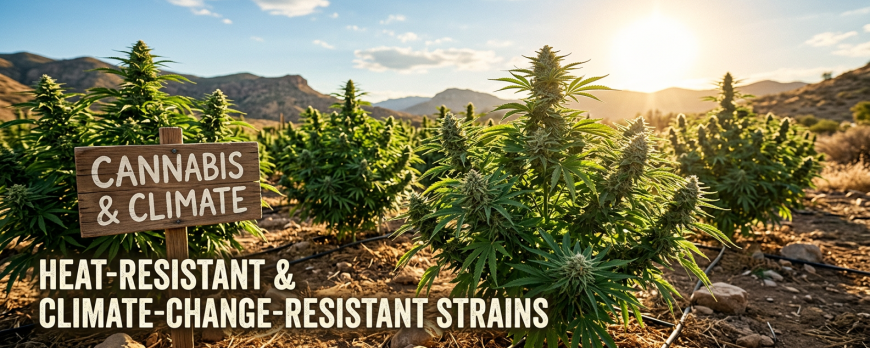
As growing seasons across Europe swing between record-breaking heat waves and sudden cold snaps, the genetics you start with matter more than ever.
But "resilient" isn't one single trait — a strain bred to thrive under blazing, consistent sun is solving a very different problem than one bred to survive an unpredictable season that might bring drought in July and a cold front in September.
Understanding that distinction, and choosing seeds that actually match the conditions you're growing in, is what separates a strong harvest from a wasted season.
Two Different Kinds of Resilience
Heat-resistant strains are genetics that are specifically comfortable in sustained warmth and strong, direct sunlight — typically Mediterranean, southern European, or similarly hot climates.
They're often descended from sativa-leaning or landrace genetics adapted to naturally hot regions, and they tend to handle high daytime temperatures without the leaf curl, nutrient lockout, or slowed growth that heat-sensitive strains suffer from.
The trade-off is that these varieties are specialists: they're bred to excel in heat, not necessarily in cool, damp, or highly variable conditions and outdoor growers further north may see them underperform without a greenhouse or an unusually warm summer.
Climate-change-resistant strains, by contrast, are built for volatility rather than heat specifically. These are genetics selected for their ability to shrug off whatever a season throws at them — a heat spike one week, a cold snap the next, a spell of high humidity that would otherwise invite mold, or pest pressure that spikes when weather patterns shift.
Their strength is adaptability: strong immune-style resistances to fungi, disease, and pests, and forgiving growth even when light, temperature, or moisture aren’t ideal.
The trade-off is that they're generalists rather than specialists — they won't necessarily outperform a true heat-lover during a long, stable heat wave, but they're far less likely to fail outright when conditions turn erratic.
Both categories solve real problems, but they solve different ones, and confusing them is one of the most common — and costly — mistakes a grower can make.
The Cost of Choosing Wrong
The consequences of mismatching a strain to your actual climate rarely show up on day one.
They show up mid-season, when it's too late to start over. A heat-specialist strain planted outdoors in a cool, humid region can stall, stretch weakly for light, or develop mold in damp late-summer weather it was never bred to handle.
A grower who assumes any "resilient" strain will do, without checking whether it's suited to heat or to volatility, may find their plants collapse the moment a heat wave or an unexpected cold snap hits.
Financially, that mismatch compounds. You've already paid for the seeds, the soil, the nutrients, the water, and months of your own time — all of which is spent regardless of whether the harvest succeeds. A failed or badly underperforming crop means paying those same costs again next season, on top of losing the yield you were counting on.
Over several seasons, growers who keep guessing at "resilience" without matching it to their specific climate challenge end up spending significantly more than those who chose the right category of seed from the start.
This is exactly why sourcing from a seed bank with clear, accurate strain data — like the Seeds Mafia catalog — matters: knowing in advance whether a strain is a heat specialist or an all-weather generalist lets you match genetics to your actual growing conditions instead of finding out the hard way.
Heat-Resistant Strains from Seeds Mafia
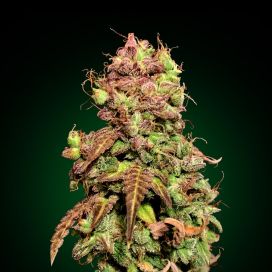
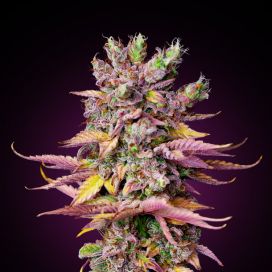
Northern Lights Feminized. Despite its cold-sounding name, Northern Lights prefers warm and Mediterranean climates when grown outdoors. With around 24% THC and a fast 7–8 week flowering time, it rewards strong, consistent sun with dense, resin-heavy buds and a solid 580–630 grams per plant by its September outdoor harvest — making it a strong pick for southern and central European growers with reliably hot summers.
White Widow CBD Feminized. This autoflowering, balanced 6–7% THC / 8% CBD variety carries White Widow's classic genetics, that gives much better results in southern, warmer climates, while still adapting further north with enough supplemental light. For growers in genuinely hot regions, it's a low-key, easy-to-manage option that leans into the heat rather than fighting it.
Sour Diesel Feminized. It’s best suited to indoor growing or a warm climate for outdoor cultivation, this California-bred sativa is a clear heat specialist. It's a strain to reach for specifically when you can guarantee strong, sustained warmth — and one to avoid if your outdoor season runs cool or unpredictable.
Climate-Change-Resistant Strains from Seeds Mafia
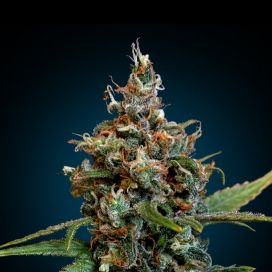
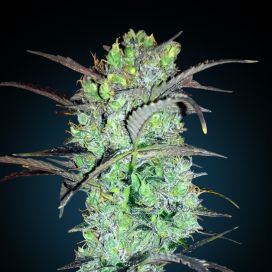
Mafia Skunk Feminized. A cross of White Widow, Northern Lights, and Skunk, this hybrid is high resistance to diseases, fungi and other parasites during the growth period, alongside high adaptability to environments without light. That combination of disease resistance and low-light tolerance makes it a genuinely all-weather performer, holding onto its roughly 700 g/m² yield potential even through grey, humid, or inconsistent stretches of weather.
Auto Big Cheese Feminized. This strain, which is resistant to weather changes and pest attacks, reflects the kind of volatility that growers face as a result of climate change. Its autoflowering nature also means a fast, predictable life cycle, reducing the window of exposure to any single bad-weather event.
Auto LSD Feminized. Its tolerance to adverse environments alongside a short 65-day life cycle shows that Auto LSD is built to finish quickly and shrug off rough patches along the way, making it a dependable choice when you can't count on a stable season from start to finish.
Choosing the Right Category for Your Grow
Before buying, be honest about which problem you're actually solving: are you growing somewhere reliably hot, where a heat-specialist strain can fully express its potential? Or are you growing somewhere increasingly unpredictable, where surviving volatility matters more than thriving in any single condition?
Getting that answer right — and buying from a source that documents it clearly — is what turns "resilient" from a marketing word into a genuine advantage.
You can compare the full grow specs for these and other varieties on the Seeds Mafia catalog, and choose the genetics that actually match the season ahead of you.